
Windham Previous Residents by Era
An address trail changes with the date. Windham deeds provide the longest ownership line, while directories and maps supply dated clues about use and occupancy. The current assessor card is the bridge: its parcel, account, map, owner, mailing, and prior-sale fields point toward the right recorded instruments. It must still be dated, since an assessment card is not a live title certificate.
| Source | Years It Covers | Where Held | What It Shows |
|---|---|---|---|
| Recorded books and indexes | Books 1687-1965; indexes 1706-1977; land records from 11/24/1965 | Windham Town Clerk and SearchIQS | Parties, instrument, date, book/page, and images when available |
| Address directories | 1909-1910, 1938-1939, and a 1984-1985 criss-cross lead | ECSU, Digital Windham, and Library of Congress guide | Dated name, street, business, or civic links |
| Sanborn maps | 1887, 1892, 1897, 1903, 1908, 1914, 1924 | Yale, Library of Congress, and ECSU | Building footprint, street, and use context |
| Assessor and AxisGIS | Current card; 2023 revaluation | Windham Assessor and AxisGIS | Parcel keys, owner and mailing fields, values, and prior assessment |
| Probate and civil | Probate generally from 01/05/2011; civil display varies | Connecticut Probate and Judicial portals | Estate, fiduciary, party, and transfer context |
Each source answers a different question. A deed names parties to a transfer, a directory prints a household or business association for one publication year, and a map shows the built setting. None alone identifies every previous resident. Keep the role and date beside each name.
Anchor the Windham Address
Start at the Windham Assessor and the linked AxisGIS parcel viewer. Search by street address, owner, or parcel ID. If the address fails, shorten the street text or test a different suffix. Human-entered assessor data may not match the form used in an old book.
Record the situs address, parcel ID, map or account key, current owner, owner mailing address, and card date. Situs means the physical site. A mailing address may be elsewhere, and neither field proves who stayed at the property. The parcel key is more stable than a postal label and links deeds, permits, tax entries, and historic maps.
Windham, Willimantic, North Windham, South Windham, and Windham Center can all appear in address evidence. Keep the source's printed place name instead of silently changing it.
Walk Windham Deeds Backward
The SearchIQS Windham index provides guest searching. Connecticut has no current county recorder, so the Windham Town Clerk, not a Windham County office, controls municipal land records. Work from the newest known owner toward the oldest relevant date.
- Find the deed in which the current owner appears as grantee, the party receiving the property.
- Save the grantor, recording date, instrument type, book/page, instrument number, and legal-description or image status.
- Search that grantor as an earlier grantee. Try surname first, initials, spelling variants, and the option that ignores party type.
- Repeat the handoff. Keep deeds, mortgages, releases, easements, liens, maps, and probate papers as distinct records.
- When the modern index stops, use Index Books or ask the Town Clerk for an original or certified copy.
A no-result is not the end. Retest with a shorter surname, wider dates, book/page, and the Index Books tab. SearchIQS lists land-record index data and images from November 24, 1965, grantor/grantee index books from 1706 through 1977, and record books from August 3, 1687 through the end of 1965.
- Grantor
- The party transferring an interest.
- Grantee
- The party receiving an interest.
- Chain of title
- The linked sequence of recorded transfers for one parcel.
- Legal description
- The recorded land description used even when a street label changes.
Windham Index Versus Image
An index entry points to an instrument. It is not the full record. SearchIQS may show party roles, document type, date, book/page, and an image link, but older results can lack a scan. The vendor's Windham help page explains the divide between current land records, historical index books, and older record-book images.
Review the Windham record coverage and image distinctions before treating a blank screen as a missing record.
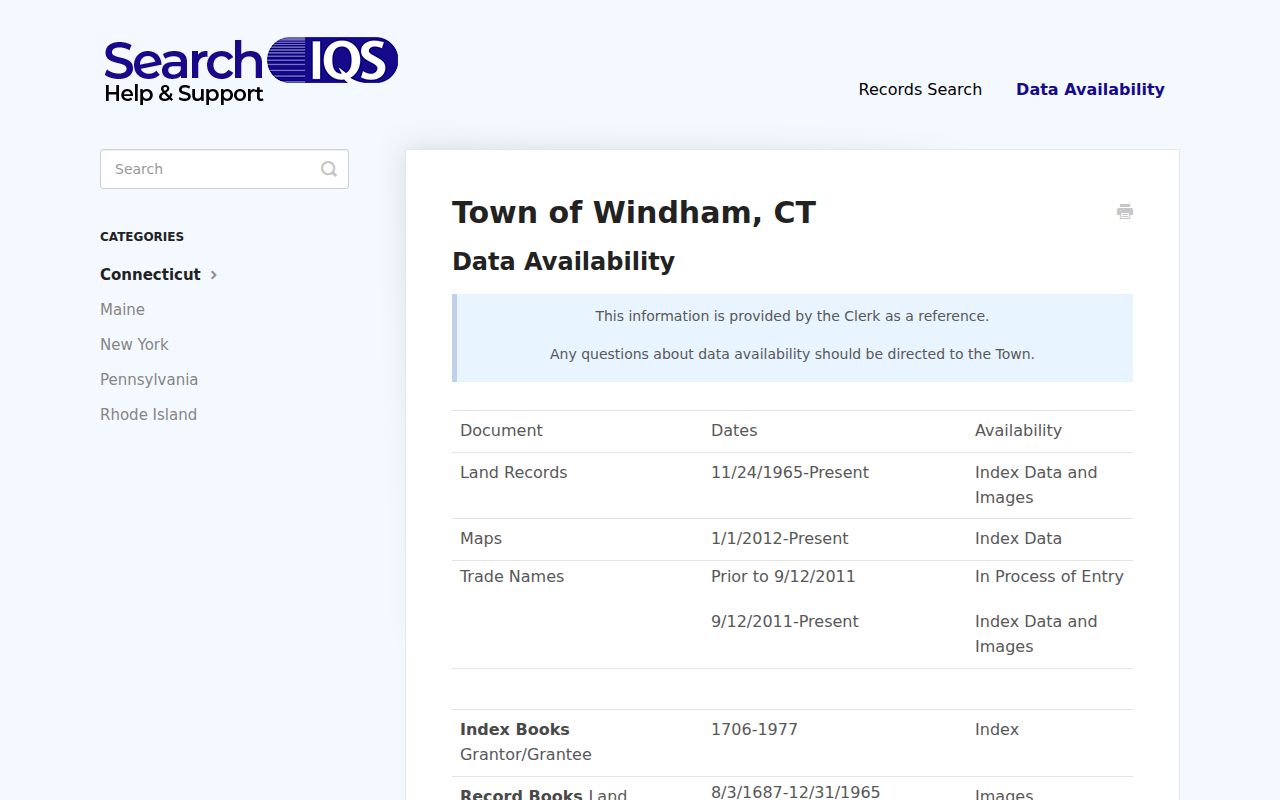
The capture makes a key distinction visible: coverage differs by series. If OCR, an index, and a scan disagree, the Town Clerk's signed or printed original controls. SearchIQS states a per-image download or print charge for a free account; check the live screen before paying.
Note: Maps are listed as index data from 2012, so ask the clerk about an image rather than assuming one is online.
Match Windham Past Households
Deeds explain ownership, but previous residents may appear only in directories, newspapers, census records, church material, or probate. Use one dated name-and-address pair at a time. Digital Windham verifies a 1938-1939 Price & Lee directory covering Willimantic, Windham, and Coventry, plus cited 1909-1910 entries. A Library of Congress guide identifies a 1984-1985 Willimantic criss-cross lead, though the local holding needs confirmation.
Address → dated directory entry → census year → newspaper or obituary → probate or deed transfer
Search a directory year on each side of a census year. Note each spelling, initial, household reference, and street form. Then compare the address and relationship data with census evidence. A criss-cross directory is arranged by street address rather than surname. It can answer who lived here before for its publication year, but cannot prove ownership or a move date.
The collections are described on the Windham city directory page. Here they serve one task: filling human gaps between recorded transfers.
Use house history lawfully. Follow past residents for genealogy, estate work, or building history. Stop if the trail would expose or endanger a living person.
Map Old Windham Addresses
Sanborn fire-insurance maps add the block, building outline, and historical use. Yale lists Willimantic sheets for 1887, 1892, 1897, 1903, 1908, 1914, and 1924. Digital Windham also has a 1903 map and 1909 aerial item. These help when a building survives but its number, use, or place label has changed.
Compare the map date with a directory date and the present parcel. Mark each uncertain match. Windham research found no official dated street-renaming or renumbering list, so an old number should not be joined to a modern parcel from appearance alone. The Assessor, Planning office, Town Clerk, and recorded map or deed form the fallback chain.
A map shows the structure, a directory shows a dated person or business entry, and a deed shows a recorded interest. Together they support a former-resident claim more strongly than any one source.
Windham Archives Fill Gaps
When the web trail ends, use the Connecticut State Library genealogy and history guides. They route researchers to town documents, directories, census material, probate, maps, newspapers, and finding aids. The ECSU Center for Connecticut Studies holds regional manuscripts, directories, reports, military rolls, newspapers, and census material by appointment. Willimantic Public Library provides local reference and news database access under its own rules.
The State Library screen shows why a previous residents search must include catalogs and staff help, not just public name boxes.
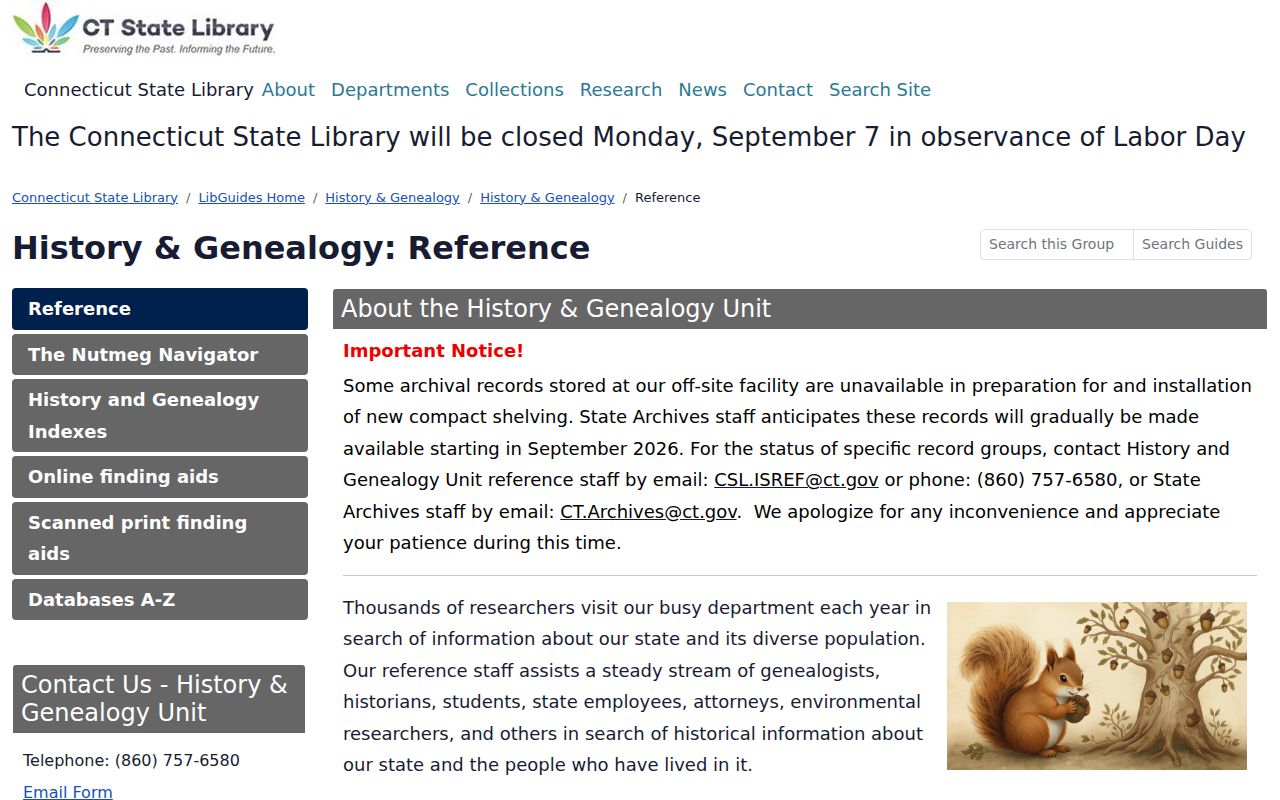
The guides can identify whether an item is an index, transcription, scan, or physical volume. Ask with an exact address, date range, printed place name, and known person. Jillson House can add local context and referrals, but no complete public Windham reverse-directory inventory was found.
Explain Windham Ownership Breaks
An estate, trust, or family transfer can interrupt a simple seller-to-buyer chain. The Windham-Colchester Probate District 28 case lookup generally reaches matters from January 5, 2011. A fiduciary is a person authorized to manage an estate or trust. That role does not mean the fiduciary lived at the property.
For older matters, use the Probate Court, State Library, historical newspapers, and the deed recorded after the estate action. An obituary may connect family members and dates, while the deed proves the recorded transfer. The Willimantic Library's Chronicle access and Digital Windham newspaper indexes are useful leads, but preserve issue, page, and image status.
Windham County is only a historical or geographic label here. Probate District 28, the Windham Judicial District, and the Town of Windham have different boundaries and custodians.
Willimantic Changes Windham Searches
Windham incorporated in 1692 and took its present shape in 1857. Willimantic later had a separate city identity before consolidating with Windham on July 1, 1983. That history explains why one place can be cataloged under Willimantic, Windham, or Windham County.
Preserve the place printed in the source, the present legal town, and the postal label. Search each relevant form. A pre-1983 Willimantic directory entry can be sound historical evidence even though the current parcel belongs to the Town of Windham. It still needs an address match and date.
This is Windham's key address-history quirk. Record custody changes by era, not through one county office. Older books may remain with the Town Clerk or State Library while a twentieth-century directory is at ECSU and a modern parcel is in AxisGIS.
Grade Windham Previous Residents
Label each conclusion by what it proves. “Owner of record” fits a dated deed or assessor result. “Listed at address” fits a directory or newspaper item. “Estate connection” fits a probate role supported by a case file. Reserve “previous resident” for a source that ties the person to the address, not merely to a parcel, owner, business, or civic group.
A strong result often has two independent links, such as a dated directory entry plus a census household, or an obituary plus probate and deed evidence. A deed without an occupant source supports past ownership only. A historical map without a name supports block and building context only.
Stop at the last verified record. Missing directory years, absent images, altered street labels, and protected records are honest limits, not gaps to fill with guesses.